Every month when your salary comes in, you feel good for about 48 hours. Then the EMIs go out, rent gets paid, groceries happen, and by the 25th you are wondering where it all went. That little voice in your head asks: Am I actually saving enough?
Here is the truth. You are not alone. This conversation comes up repeatedly among salaried professionals across India. The good news? There is a remarkably simple framework that can help you build serious wealth without needing a finance degree. It is called the 15-15-15 rule.
What Is the 15-15-15 Rule?
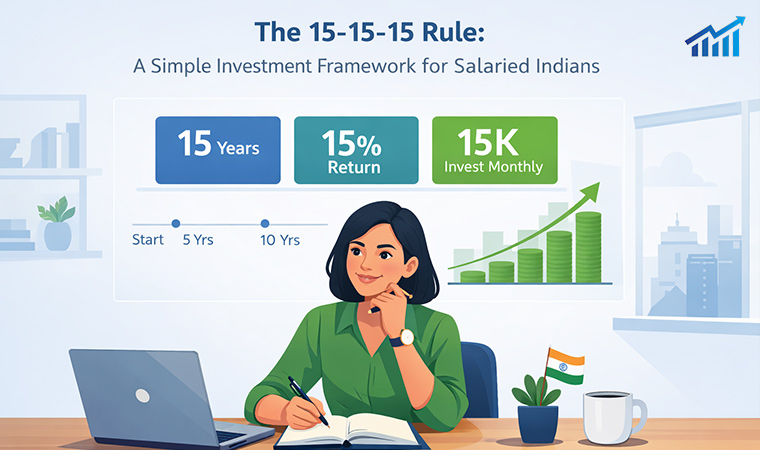
Think of it as your wealth-building recipe with three ingredients:
-
Invest ₹15,000 every month through a SIP
-
Keep doing this for 15 years straight
-
Aim for roughly 15 percent returns annually
Before you think “I cannot afford ₹15,000” or “15 percent sounds impossible,” understand that these numbers are not rigid. If you earn ₹40,000 monthly, you might start with ₹8,000. The principle matters more than the exact amounts.
How This Actually Works
Meet Priya, 28, working in marketing in Mumbai, earning ₹60,000 monthly. She starts investing ₹15,000 every month in equity mutual funds.
Fast forward 15 years. Priya has invested ₹27 lakhs of her own money. But if her investments averaged around 15 percent annually, that could grow to approximately ₹1.01 crore by age 43.
Let me be upfront. This is not guaranteed. Markets fluctuate. Some years deliver 25 percent, others show losses. The 15 percent figure is based on historical long-term equity market performance. Your results may vary.
But the point stands. Consistent investing over time turns modest monthly amounts into significant wealth.

Why This Works for Salaried People
Your salary typically increases almost every year. What feels tight today becomes comfortable in two years. Automation makes it effortless. Once you set up an auto-debit SIP, the money leaves before you can spend it elsewhere.
Plus, this works alongside your EPF. Your company builds a debt portfolio through provident fund contributions. Equity SIPs can become the growth engine. Together, they create a balanced portfolio.
Where to Invest This Money
Equity mutual funds have been the go-to for long-term wealth creation in India. Large-cap funds invest in stable companies but grow slower. Mid-cap and small-cap funds target higher growth but with bigger swings.
Many investors split their investments across fund categories. For instance, allocating part to a flexi-cap fund and part to a mid-cap fund can provide diversification while maintaining growth potential.
The 15-year timeline is crucial. It lets you ride out bad years. Markets crashed in 2008 and 2020, but people who stayed invested came out ahead.
Tax Efficiency Matters
Long-term capital gains above ₹1.25 lakh from equity funds attract 12.5 percent tax. Short-term gains get taxed at 20 percent. While equity funds do not offer Section 80C deductions, they often deliver better after-tax returns over 10 to 15 years compared to traditional tax-saving instruments.
Five Mistakes to Avoid
Stopping SIPs when markets fall is perhaps the biggest mistake. You are actually buying more units at lower prices, which becomes valuable when markets recover.
Checking your portfolio daily creates unnecessary anxiety. Quarterly reviews are typically sufficient. Starting aggressive SIPs without three to six months of expenses in an emergency fund is risky.
Blindly copying someone else’s fund choices ignores your unique situation. Different goals need different strategies. Expecting smooth returns sets you up for disappointment. Focus on long-term averages, not yearly swings.
Is This Right for You?
This approach works well if you are between 25 and 40, earning steady income, without crushing debt, and will not need this money for 10 to 15 years.
However, if you have high-interest debt like credit cards, clearing those first makes mathematical sense. If you are nearing retirement in five years, equity-heavy strategies carry too much timing risk. And if ₹15,000 means skipping essentials, starting smaller makes more sense. Even ₹5,000 monthly builds wealth over time.
Time to Start
Building wealth is not about perfection. It is about consistency. You do not need to time the market or become a financial genius. Just start, keep going, and let compounding work.
The 15-15-15 rule provides a roadmap. You can adjust it to your situation. Maybe it is 10-15-15 or 20-10-12 for you. The habit matters more than exact numbers.
The best time to start was 15 years ago. The second-best time is today. If you need help customizing this to your specific situation, consider speaking with a SEBI-registered financial advisor who can provide personalized guidance.
Important Disclaimer
This article is purely educational and should not be considered investment advice or a recommendation to buy or sell any securities. Mutual fund investments are subject to market risks, and past performance does not guarantee future results. The 15 percent return mentioned is illustrative based on historical data and is absolutely not a promise or guarantee.
Please read all scheme-related documents carefully and consult with a qualified, SEBI-registered financial advisor before making any investment decisions. Tax laws change, and your individual tax situation may differ from the examples discussed here.