
Every Indian borrower faces this question. Should I prepay my home loan or invest the money elsewhere for higher returns. Here is how to actually think it through.
Beta, Loan Khatam Karo Pehle
If you have a home loan, chances are someone in your family has already given you this advice. Your father. Your father-in-law. Your older colleague at office. The message is always the same: finish the loan first. Everything else can wait.
And honestly, there is wisdom in that instinct. Debt does feel heavy. An EMI that shows up every single month, for twenty years, is not something most people carry lightly. The dream of being loan-free, of owning your home outright, is deeply meaningful for most Indian families.
But here is the question that financial planners are increasingly asking their clients: what if that instinct, however emotionally satisfying, is not always the smartest use of your money?
In 2026, with home loan rates floating between 8.5% and 9.5% and equity mutual funds continuing to attract record SIP inflows, this debate has moved from dinner table conversations to serious financial planning discussions. This article will help you think it through. With real numbers, not just gut feeling.
Where Does Your EMI Money Actually Go?
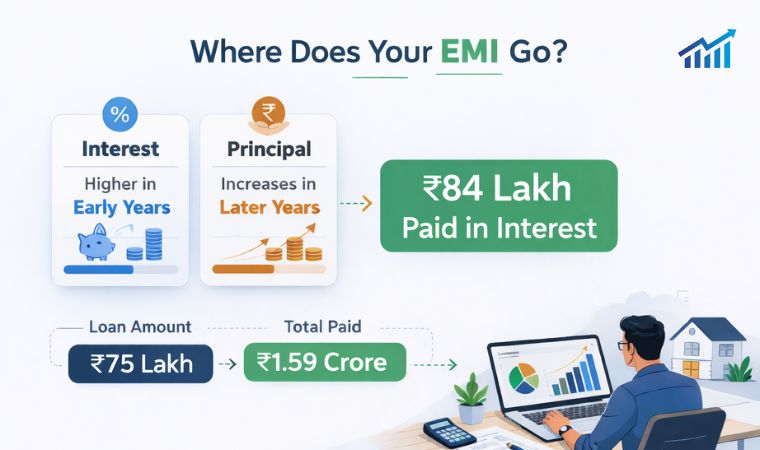
Most salaried borrowers know their EMI to the last rupee. But surprisingly few have ever looked at their loan amortisation schedule. This document shows exactly how that EMI is split every month between interest and principal repayment.
If you pull that document out today, you will likely be surprised. In the early years of a home loan, a very large portion of your EMI goes straight to the bank as interest. Very little actually reduces the loan amount you owe. It is only in the later years, sometimes from year ten or twelve onwards, before it starts to meaningfully shift in your favour.
This is not a trick. It is simply how home loans work. But it has an important implication: if you are going to prepay, the earlier you do it, the bigger the impact. A lump sum paid in year three saves far more interest than the same amount paid in year twelve.
Let us put some numbers to this so it becomes real.
The True Cost of a Rs. 75 Lakh Home Loan
| Loan Detail | Amount |
| Loan amount taken | Rs. 75,00,000 |
| Rate of interest (floating) | 8.75% per year |
| Loan tenure | 20 years |
| Monthly EMI (approx.) | Rs. 66,200 |
| Total paid to bank over 20 years | Rs. 1,58,88,000 |
| Total interest paid (approx.) | Rs. 83,88,000 |
Read that again. You borrow Rs. 75 lakh. Over twenty years, you end up paying the bank more than Rs. 83 lakh just as interest. That is more than the original loan itself, paid purely for the cost of borrowing. By the end of the tenure, you have paid nearly Rs. 1.59 crore for a Rs. 75 lakh loan.
This is why the idea of prepaying feels so right. You are not just reducing a number on paper. You are stopping a very real and very large outflow from your household.
So What Happens When You Prepay?
When you make a lump sum payment toward your loan principal, you reduce the amount on which interest is being calculated every month. Less principal means less interest. Less interest means either your EMI reduces, or your loan closes sooner, whichever option your bank offers you. (Most financial planners recommend keeping the EMI the same and reducing the tenure. You save more that way.)
The simplest way to think about prepayment returns: whatever your loan interest rate is, that is exactly what your prepayment earns you, in the form of guaranteed savings. No stock market. No fund manager. No volatility. Just a certain, locked-in saving.
What Does a Rs. 5 Lakh Prepayment in Year 3 Actually Do?
| Without Prepayment | With Rs. 5 Lakh Prepaid in Year 3 | |
| Remaining loan period | 17 years | Approx. 15 years 4 months |
| Interest saved (approx.) | N/A | Rs. 8 to 10 lakh |
| Return on your Rs. 5 lakh | N/A | ~8.75%, fully guaranteed |
Think of it this way: prepaying your home loan is like putting money in a fixed deposit that pays you 8.75% per year, except better, because there is no tax on the saving, and the return is absolutely certain.
For someone nearing retirement, or someone who simply cannot sleep soundly with a large loan hanging over them, that certainty has real value. Not everything in personal finance is about maximising the number. Sometimes peace of mind is the best investment.
But What If You Invested That Money Instead?
Now let us look at the other argument. The one your younger colleague at office, or the personal finance influencer you follow on YouTube, is probably making.
India’s equity mutual fund industry has matured considerably. Monthly SIP inflows have crossed Rs. 25,000 crore. Millions of salaried Indians are now investing regularly and seeing the results of compounding play out over ten and fifteen year periods. The data, over long stretches, is genuinely encouraging.
So what would happen if, instead of prepaying Rs. 5 lakh toward your loan, you put that money into a well-diversified equity mutual fund and left it alone for fifteen years?
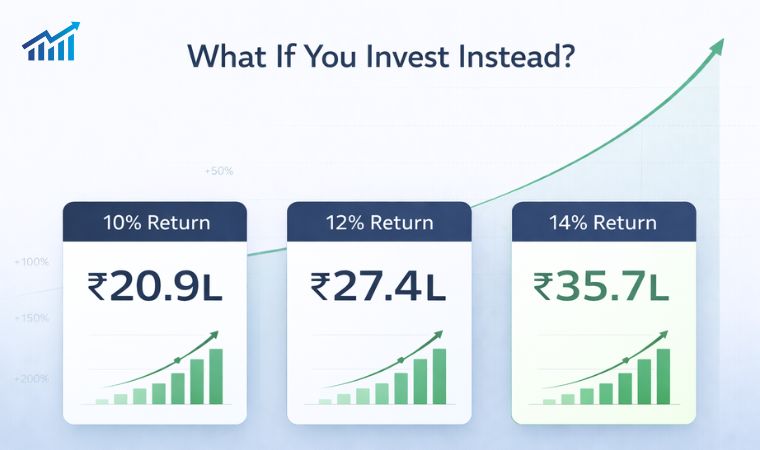
Rs. 5 Lakh Invested for 15 Years: Possible Outcomes
| If the fund grows at… | Your Rs. 5 lakh becomes… |
| 10% per year | Approx. ₹20.9 lakh |
| 12% per year | Approx. ₹27.4 lakh |
| 14% per year | Approx. ₹35.7–₹36 lakh |
Compared to the Rs. 8–10 lakh saved through prepayment, these numbers look very attractive. And if you are a long-term, disciplined investor, the case for investing over prepaying is mathematically strong, especially over fifteen years or more.
But here is the important part: those are projected numbers assuming you stay invested through every market correction, every budget panic, every global crisis that sends indices tumbling for months. In 2020, Nifty fell nearly 38% in five weeks. Many investors who had planned to stay the course quietly redeemed their funds. They locked in their losses and missed the recovery that followed.
This is not said to scare you away from equity investing. It is said to help you be honest with yourself. If you are the kind of person who checks their portfolio every week and gets anxious when it goes red, the theoretical upside of investing over prepaying may not translate into actual returns for you.
The Number Most People Miss: Your Loan’s Real Cost After Tax
Here is where the analysis gets a little more nuanced, and where many people are making their comparison incorrectly.
If you are on the old tax regime, the government gives you two useful deductions on your home loan. Under Section 24(b), you can deduct up to Rs. 2 lakh per year from your taxable income for the interest you pay. Under Section 80C, you can deduct up to Rs. 1.5 lakh for the principal repaid. These deductions reduce your tax outgo, which means your loan is effectively costing you less than the stated rate.
Your Home Loan’s Real Cost, After Claiming Tax Benefits
| Your Income Tax Slab | Stated Loan Rate | What It Actually Costs You |
| 20% slab (old tax regime) | 8.75% | Around 7.2% effectively |
| 30% slab (old tax regime) | 8.75% | Around 6.5% effectively |
| New tax regime (no deductions) | 8.75% | Full 8.75%, with no reduction |
If you are a senior manager or professional in the 30% bracket on the old regime, your home loan is effectively costing you closer to 6.5% per year. At that rate, long-term equity investments, which have historically averaged 11 to 13% over fifteen-year periods in India, have a much stronger case against prepayment.
On the other hand, if you have moved to the new tax regime (which many salaried employees have, given the simplified slabs), you do not get these deductions. Your effective loan cost stays at 8.75%, making the comparison tighter and prepayment relatively more attractive.
Before you make any decision, find out your effective home loan rate after tax. It takes ten minutes with your chartered accountant or even a good tax calculator. That single number will clarify the entire debate for you.
The Feelings Part That Nobody Wants to Admit Matters
Indian families have a complicated relationship with debt. For our parents’ generation, borrowing money, any kind of money, carried a certain stigma. You paid it back as fast as you could. You did not talk about it openly. You certainly did not borrow money to invest in the stock market while still carrying a home loan.
That cultural context is real, and it shapes how many of us feel about our EMIs, even when the loan is objectively manageable. If your parents call every few months and ask when the loan will be finished, you know what we mean.
But there is also a very practical financial concern here: liquidity. Money that you prepay into your home loan is gone, locked into the property. You cannot call your bank one afternoon and ask them to return the Rs. 5 lakh you prepaid two years ago because your child’s college admission came through unexpectedly. That flexibility disappears the moment you prepay.
This is why financial planners consistently advise: before any prepayment, make sure you have a proper emergency fund, typically six to nine months of household expenses, sitting in a savings account or liquid mutual fund. That buffer is non-negotiable. It should be built before you make a single rupee of loan prepayment.
When Prepaying Is Clearly the Right Call
There are specific situations where paying off the loan faster is the obviously correct decision. No debate needed.
If retirement is five to seven years away, you should be aggressively reducing your loan. Entering your sixties with a large EMI obligation, at a time when your income will likely fall or become irregular, is a genuine financial risk. The goal should be to reach retirement debt-free, or very close to it.
If your EMI is consuming more than 40 to 45 percent of your take-home salary, that is too much pressure on your monthly cash flow. Prepaying to reduce the burden is not just financially sensible. It also reduces the kind of chronic financial stress that affects health, relationships, and work performance.
If you have tried investing before and found yourself unable to hold on during bad markets, if you redeemed your mutual funds in March 2020 or during the 2022 correction, be honest about that. The guaranteed return from prepayment will serve you better in real life than the theoretical return from investing that you will not actually capture.
And if your loan tenure is already down to five years or fewer, the interest savings from prepayment are smaller. At that stage, it often makes more sense to simply close the loan, enjoy the psychological relief, and then redirect your entire erstwhile EMI amount into a systematic investment plan.
When Investing Your Surplus Makes More Sense
If your situation looks different, with stable income, a long career ahead, a manageable EMI and a proper emergency fund in place, then the numbers often favour investing over prepaying.
A 35-year-old with fifteen or more earning years ahead of them is in a genuinely powerful position. Equity compounding over that kind of time horizon does extraordinary things to money. The opportunity cost of not investing, of putting every surplus rupee into the loan instead, can be very large by the time retirement arrives.
If you are the kind of person who set up a SIP two years ago and has not touched it since, not because you forgot but because you understand that is the right approach, you are exactly who this argument is made for. Disciplined, patient investing over long periods is one of the most reliable paths to real wealth creation in India today.
Higher-bracket taxpayers on the old regime have an especially strong case for holding onto the loan. When your effective loan rate is 6.5%, and you have a fifteen-year investment horizon, redirecting surplus into equity is not just acceptable. It is arguably the more financially mature decision.
The Practical Middle Path: What Most People Should Actually Do
Here is the honest truth: most salaried Indian borrowers do not fall neatly into either camp. You are not purely debt-averse, and you are not purely a disciplined long-term investor. You are somewhere in between. That is completely normal.
For most people in that position, the smartest approach is a split strategy. Not because it is a compromise, but because it genuinely optimises both outcomes simultaneously.
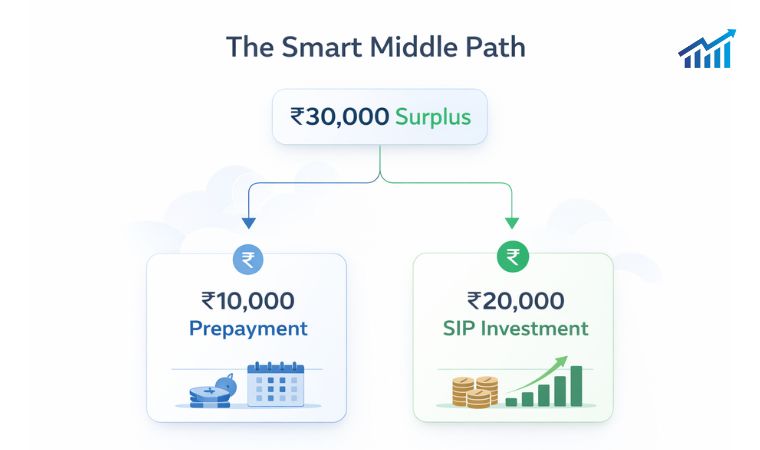
The framework is simple: build your emergency fund first. No shortcuts here. Then split your monthly or annual surplus between a periodic loan prepayment and a regular SIP. Even a 50-50 split puts you ahead of doing nothing on either front.
Say you have Rs. 30,000 of surplus each month after all expenses and your regular EMI. You could set aside Rs. 10,000 every month and make one focused prepayment at the end of the year. That is Rs. 1.2 lakh going directly toward reducing your principal. The remaining Rs. 20,000 goes into a diversified equity mutual fund SIP every month, compounding quietly in the background.
Over time, as your salary grows and your loan balance shrinks, you can revisit the split. Maybe in three years you shift to Rs. 8,000 toward prepayment and Rs. 22,000 toward SIP. There is no single correct ratio. It evolves with your life.
What matters is that you are making a deliberate, considered decision rather than defaulting to one extreme because of emotion or inertia.
The Loan Is a Tool. So Is Your Investment. Use Both Wisely.
Here is the reframe that changes everything: your home loan is not your enemy. It is a financial instrument, one that came with tax benefits, helped you build a physical asset, and gave your family a home. Paying it off is a milestone worth celebrating. But it is not always the most financially optimal thing to do with every rupee of surplus you generate.
At the same time, investing is not a magic answer. Markets go up and down. Discipline is hard to maintain. And a mutual fund portfolio, however well constructed, does not pay off your loan when you need liquidity.
The right answer sits somewhere between your father’s advice and your financial planner’s spreadsheet. It depends on your tax bracket, your temperament, your age, your income stability, and honestly, how much you sleep soundly with debt in the picture versus how much you trust yourself to stay invested when things get uncomfortable.
At Alpha Grace Fusion, we believe good financial decisions are built on honest numbers and self-awareness. Not on what worked for your neighbour. Not on fear. Not on the excitement of projected returns. The math should guide you. But the decision must fit your life.
Important Disclaimer
This article is purely educational and should not be considered investment advice or a recommendation to buy or sell any securities. Mutual fund investments are subject to market risks, and past performance does not guarantee future results. The returns mentioned is illustrative based on historical data and is absolutely not a promise or guarantee.
Please read all scheme-related documents carefully and consult with a qualified AMFI-registered mutual fund distributor before making any investment decisions. Tax laws change, and your individual tax situation may differ from the examples discussed here.